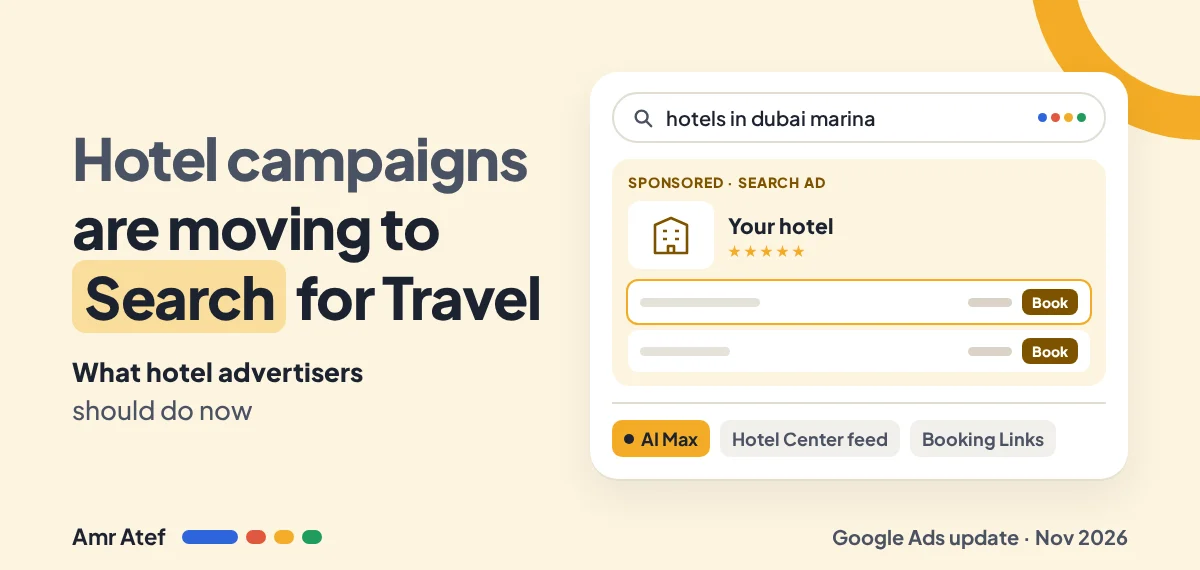
Your Hotel campaign has an expiry date. Google confirmed it on November 18, 2026, when it published a full help hub for Search campaigns for Travel and stated plainly that Hotel campaigns will move into them. You can wait for Google to migrate your account for you, or you can build the new setup yourself while you still have your old campaign running as a benchmark. I’d pick the second option, and this article is the playbook for it.
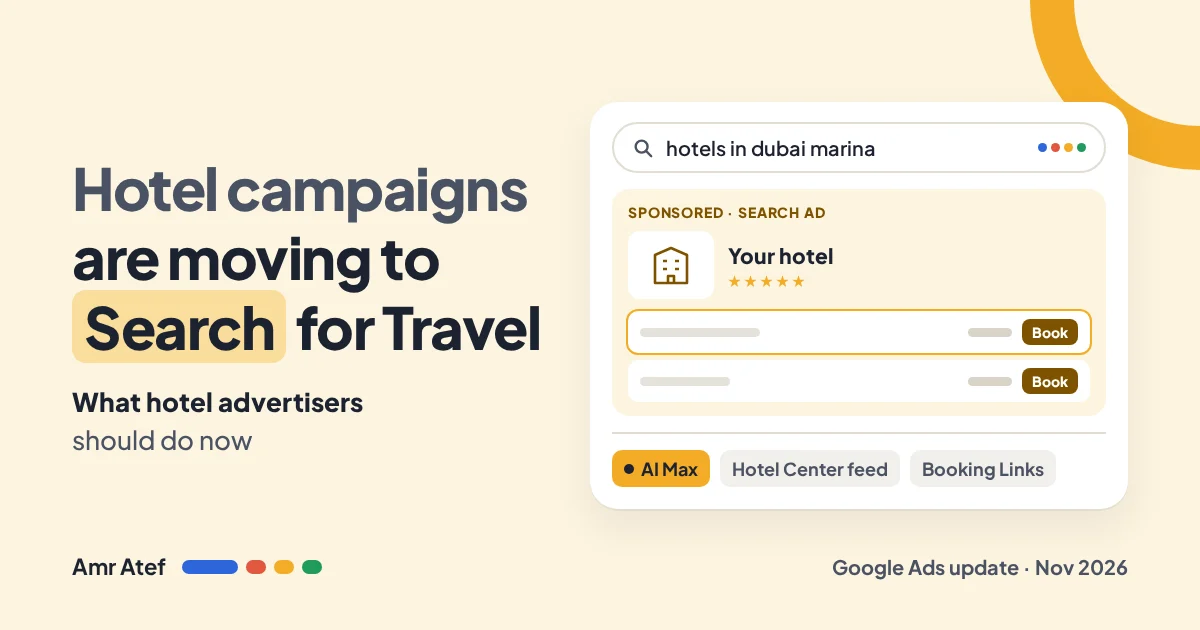
Quick answer: Search campaigns for Travel are standard Search campaigns with AI Max turned on and a travel feed selected (Hotel Center for hotels and vacation rentals, Actions Center for things to do and events). Hotels get three formats in each ad group: text ads, Travel Promotion Ads and Booking Links. Google says Hotel campaigns will move to this setup and that you’ll be notified before any change. The smart move is to build one now with your hotel feed and run it next to your Hotel campaign.
- No AI Max, no travel formats. It’s a hard requirement.
- Booking Links only serve in ad groups that have an item group.
- eCPC and CPC% bidding don’t exist in the new campaigns. Plan your bidding switch now.
What Are Search Campaigns for Travel?
Until now, hotel advertisers on Google ran two worlds. Search campaigns with keywords and text ads on one side, and a separate Hotel campaign driven by the Hotel Center feed on the other, with its own bidding, its own reports and its own quirks.
The new setup merges them. According to Google’s help page, travel ad formats now run inside a standard Search campaign, but only when AI Max is turned on and a data feed is selected in the campaign settings. In plain words: the feed you already maintain in Hotel Center now powers ads inside Search, and AI Max decides a lot about where they show.
Google first announced Search campaigns for Travel on April 30, 2026, and the move of Travel campaigns (things to do) started in Q3 2026. The news on November 18 is the hotel side: a new help hub with setup, reporting, bidding, audiences and troubleshooting docs, plus the confirmation that Hotel campaigns are next.
Which formats you get, by vertical
| Vertical | Text ads | Travel Promotion Ads | Booking Links |
|---|---|---|---|
| Hotels | Yes | Yes | Yes |
| Things to do | Yes | Yes | No |
| Events | Yes | Yes | No |
| Vacation rentals | Yes | In pilot | No |
| Car rentals | Text ads yes, feed-based text in pilot | In pilot | No |
| Flights | No | No | No |
Quick translation of the three formats. Text ads are your normal responsive search ads. Travel Promotion Ads are feed-based ads that promote your property with images and details from the feed. Booking Links are the price and “Book” rows travellers compare. Google notes that formats and eligibility may vary by market and beta participation, so check what your account actually shows.
When Do Hotel Campaigns Migrate to Search Campaigns for Travel?
Google’s main help page doesn’t give a date. It says Hotel campaigns “will move to Search campaigns for travel” and that you’ll be notified before any change is made to your account. It also encourages you to create a Search campaign for travel with your hotel feed now, because many advertisers run both side by side to compare.
Two more data points, so you can plan:
- Search Engine Roundtable reported on November 18, 2026 that a notice across Google Ads help docs says the hotel migration starts in Q4 2026.
- Google’s migration help page says that if you take no action, active Hotel campaigns will end and replacement campaigns will be created automatically in mid H1 2027, with precise dates sent by email.
So: Google will notify you, the process is reported to start in Q4 2026, and the auto-migration for people who do nothing is described as mid H1 2027. Watch your account notifications for the real date. Don’t build your plan around a guess.
The same page holds the most useful line for anyone planning ahead: if you migrate yourself, you build the new campaigns and then pause the legacy Hotel campaigns to prevent auto-migration. You decide what gets carried over, not a copy script.
Requirements Checklist for Hotel Advertisers
Here’s what has to be true before a single travel format can serve. Miss one and the campaign runs as a plain Search campaign without telling you why.
| Requirement | Where to set it | What happens without it |
|---|---|---|
| Hotel Center linked | Tools > Data manager > Connected products > Google Hotel Center | No feed, so no Travel Promotion Ads or Booking Links |
| AI Max on | Campaign settings, AI Max toggle | Travel formats never serve |
| Feed selected | Campaign settings, Data Feeds (inherits the account feed by default) | Feed-based formats pause |
| At least one format per ad group | Ad group AI Max settings (all 3 are on by default) | You can’t save the ad group |
| Item group | Ad groups tab > Item Groups > Add item group | No Booking Links in that ad group |
Per Google’s setup guide, you create the campaign with the Sales objective and the Search campaign type, then turn on AI Max during setup. Each ad group can hold one item group with up to 20,000 rules, filtered for hotels by item ID, location or hotel class. Item groups update automatically as your feed changes. One warning from the same page: if you remove all filters, the ad group targets your entire feed.
A Side by Side Test Plan Before the Hotel Campaigns Migration
You can’t use a Google Ads experiment to compare a Hotel campaign with a Search campaign for travel. Google’s troubleshooting FAQ says experiments don’t work across campaign types, so you run both at the same time and compare.
Let’s use an example. This is hypothetical. Imagine a 4-star hotel in Dubai Marina that runs a Hotel campaign for its own property and a separate brand Search campaign. Here’s how I’d test it:
- Keep the Hotel campaign live. It’s your benchmark. Don’t change its bids or budget during the test.
- Build one new Search campaign for travel in the same Google Ads account, using the same Hotel Center feed. Google says hotels under the same account (CID) or the same feed ID don’t compete against each other. Different accounts or feeds can, and that may push your bids up.
- Structure ad groups around intent. One ad group for the property’s item group with all three formats on, and keywords like “hotels in dubai marina” and “dubai marina hotel with beach access” to help text ads and Travel Promotion Ads.
- Give it a fair share of budget and enough time for Smart Bidding to learn before you judge.
- Compare by format using the Ad format segment (more on that below), not just at campaign level.
- When the new campaign holds up, move budget across and pause the Hotel campaign yourself. That pause is what stops the auto-migration.
One note if you later test inside the new campaign: Google recommends custom experiments, not AI Max experiments, for now, and item groups you create in an experiment draft aren’t copied to the base campaign when you apply it.
Controls to Set Because AI Max Is Broad
AI Max uses search term matching, text customization and Final URL expansion to find more queries and write more variations. That’s the reach Google promises. It’s also how a Marina hotel ends up showing for “cheap hostel deira” if nobody sets limits.
- Negative keywords: Google says negatives are respected even when AI Max is on. Add the obvious ones: jobs, hostel, competitors you don’t want, cities you don’t serve. If you’re unsure how much a keyword can stretch, my guide to Google Ads match types covers it.
- Brand controls: decide whether this campaign should cover your own brand searches or leave them to your brand campaign, and set brand inclusions or exclusions to match.
- URL controls: with Final URL expansion on, AI Max can pick a landing page for you. Exclude careers, blog and policy pages. My article on AI Max URL exclusions explains how those rules actually match.
- Search term review: the search terms report now covers text ads and Travel Promotion Ads. Review it weekly in the first month. Here’s how I mine search terms.
- Location settings: Google’s migration page says the physical and interest location ValueTrack values now follow normal Search behaviour, not the Hotel campaign logic. Recheck your location targeting options before launch.
One important exception. Booking Links don’t use keywords, search term matching, brand settings or URL rules. They’re targeted only by the item group. So the controls above shape your text ads and Travel Promotion Ads, while your item group is the only steering wheel for Booking Links.
Reporting and Bidding Changes in Search Campaigns for Travel
Reporting
According to Google’s reporting page, this is the part that gets better:
- You can segment Campaign, Ad group and Search keywords reports by Ad format (text, Travel Promotion Ads, Booking Links).
- Reports for ad types, search keywords and search terms are available. They weren’t available in Hotel campaigns.
- Hotel metrics get new names: Hotel eligible impressions becomes Potential impressions, and Hotel price difference % becomes Price difference %. Price bucket keeps its name.
- Auction Insights and Performance Planner aren’t compatible with the new campaigns yet, and Ad Strength isn’t calculated for Travel Promotion Ads or Booking Links.
Tracking needs a check too. Tracking templates and custom parameters move to the ad group level, the {hotel_partition_id} ValueTrack parameter now returns the item group, and Search relies on parallel tracking. Test your booking engine links before you move real budget, and confirm your conversion tracking counts bookings from both campaigns the same way.
Bidding
Per Google’s bidding page, eCPC, commission-based CPC% and Target impression share aren’t available. Manual CPC is, but it limits AI Max features like search term matching. Google’s troubleshooting page says that to get the full capabilities of AI Max you should use a conversion or conversion value based strategy, such as Maximize Conversion Value with an optional target ROAS. If your bidding needs better signals first, read my piece on how Smart Bidding learns from your funnel.
One manual CPC detail that changes your numbers: Hotel campaigns multiplied your bid by the traveller’s length of stay. The new campaigns don’t. You use a Length of booking bid adjustment instead, capped at +900%.
Common Mistakes to Avoid
- AI Max off. The campaign runs, text ads serve, and you wonder why no hotel formats appear. Google’s FAQ answer to “is AI Max a prerequisite?” is one word: yes.
- No item group, so no Booking Links. Booking Links is ticked in the format settings, but without an item group in that ad group it never serves.
- Letting auto-migration copy bad settings. Google says it will move settings to “the most comparable functionality available”, and eCPC or CPC% campaigns get converted to manual CPC. If your Hotel campaign carries old bid adjustments or messy hotel groups, they travel with it.
- Running two accounts or two feeds for the same hotel. That’s how you bid against yourself.
- Editing images in Google Ads. Titles and images for Travel Promotion Ads and Booking Links still come from the feed. Fix them in Hotel Center.
Pre Migration Checklist
- Hotel Center linked in Data manager, feed approved and current.
- New Search campaign for travel built with AI Max on and the hotel feed selected.
- Item group added in every ad group where you want Booking Links.
- Negatives, brand controls and URL exclusions set before launch.
- Bidding moved off eCPC or CPC% to a Smart Bidding strategy you trust.
- Tracking templates moved to ad group level and booking links tested.
- Both campaigns live in the same account, compared by Ad format segment.
- Legacy Hotel campaign paused by you, once the new one proves itself.
More From the Blog
- AI Max URL Exclusions: How Google’s Token Matching Really Works
- Search Journey Awareness: How Smart Bidding Learns From Your Whole Funnel
- The Google Ads Search Terms Report
- Google Ads Location Targeting
- Demand Gen Campaigns: Updates Before Black Friday
Frequently Asked Questions
What are Search campaigns for Travel in Google Ads?
They are standard Search campaigns with AI Max turned on and a travel feed selected. Hotels can run text ads, Travel Promotion Ads and Booking Links from one campaign, using the Hotel Center feed.
When will Google migrate Hotel campaigns?
Google says you’ll be notified before any change. Trade press reports the migration starts in Q4 2026, and Google’s migration page says campaigns left alone will be auto-migrated in mid H1 2027.
Do I need AI Max to run hotel ads in Search?
Yes. Google says travel formats only serve in Search campaigns that have AI Max turned on and a data feed selected.
Why aren’t my Booking Links showing?
Booking Links only serve in ad groups that have an item group and have Booking Links selected in the format settings. They don’t use keywords, search term matching, brand settings or URL rules.
Can I use eCPC or CPC% bidding in AI Max for travel?
No. Both are unavailable. Use manual CPC or a Smart Bidding strategy instead.
Can I A/B test my Hotel campaign against the new campaign with experiments?
No. Google says experiments don’t work across campaign types. Run both campaigns at the same time in the same account and compare.
Sources
- About AI Max for travel, Google Ads Help
- Migrate Hotel campaigns to the new campaign type, Google Ads Help
- Set up AI Max for travel, Google Ads Help
- AI Max for travel reporting, Google Ads Help
- Set up bidding for AI Max for travel, Google Ads Help
- Best practices for AI Max for travel, Google Ads Help
- Troubleshoot AI Max for travel, Google Ads Help
- Set up AI Max for travel audiences, Google Ads Help
- Google Hotel Campaigns Migrating To Search Campaigns For Travel, Search Engine Roundtable, November 18, 2026
- Google’s AI Max Positions Travel Ads for AI Overviews and AI Mode, Skift, April 30, 2026
Are you building your Search campaign for travel now, or waiting for Google’s auto-migration to decide for you? Tell me on LinkedIn, and subscribe on YouTube for more Google Ads breakdowns.
About the author: Amr Atef is a Dubai-based performance marketing specialist focused on Google Ads and marketing technology, and the builder of BenaAds. He writes a practical Google Ads series for new advertisers. Follow him on LinkedIn and YouTube, or read more about Amr.
