Imagine waking up to find your face and your voice in an ad running everywhere, one you never shot. Thanks to AI, that’s now happening to many celebrities.
And as the saying goes, one person’s misfortune is another’s opportunity. If AI can copy a star’s face, why not build a business around doing it legally, with the star’s permission? That’s exactly what Ogilvy, one of the world’s biggest advertising agencies, just did with AI celebrity ads.
Quick answer: On November 9, 2026, Ogilvy launched ECHO, which it calls the industry’s first talent consent-based creative AI platform, in partnership with talent agency CAA. Stars are scanned once, their digital likeness is stored in the CAA Vault, and Ogilvy can then generate 30 to 50 ad assets from one shoot instead of 8 to 10, with the talent approving every asset before it’s published. Ogilvy estimates cost per asset could fall by up to 65 to 75%.
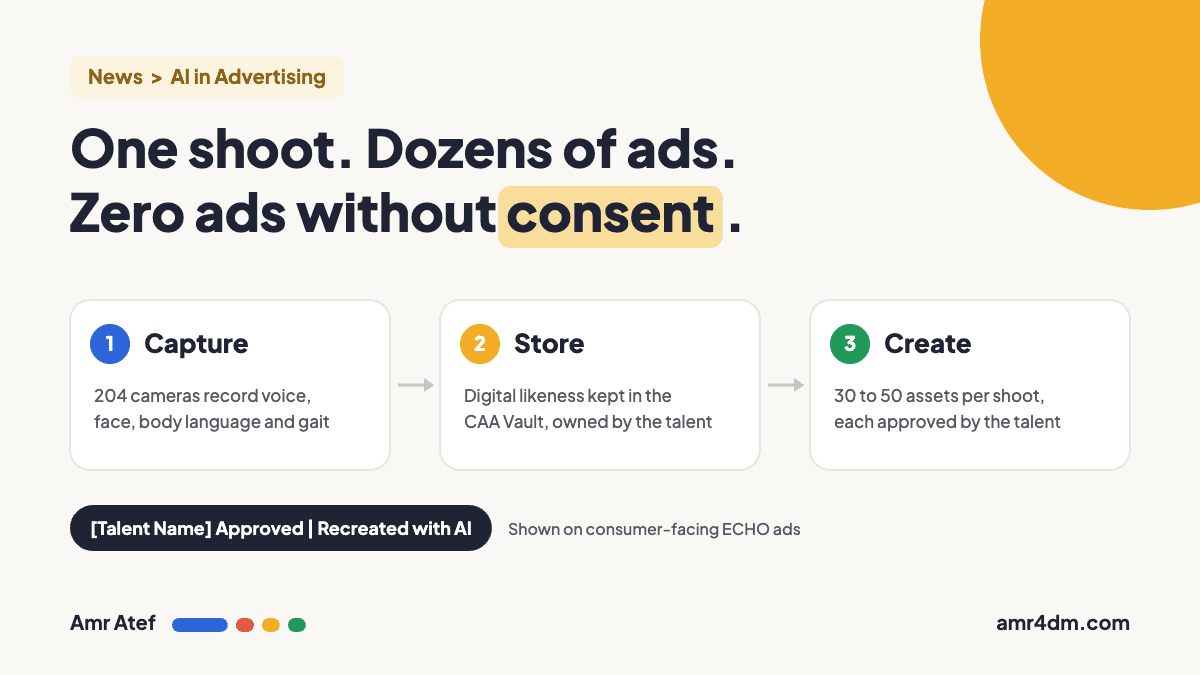
What Is Ogilvy ECHO?
ECHO is a consent-first AI platform from Ogilvy, part of WPP. Ogilvy describes it as the industry’s first talent consent-based creative AI platform. It turns a single celebrity or athlete shoot into an ongoing content system, built on a partnership between WPP and Creative Artists Agency (CAA), a talent agency that represents major actors, athletes and creators.
One correction to a common shortcut: what protects a celebrity’s face and voice usually isn’t copyright. It’s their rights over their name, image and likeness, often called publicity or likeness rights. That’s exactly what ECHO is built to license.
How AI Celebrity Ads Work With ECHO
| Step | What happens |
|---|---|
| 1. Capture | The star is scanned in a studio with 204 cameras that record their voice, body language, facial expressions and even the way they walk, according to Digiday. |
| 2. Store | The digital likeness is kept in The CAA Vault, CAA’s service for capturing, storing and licensing talent’s likeness, voice and IP. |
| 3. Control | The talent owns their digital likeness and chooses which brands and markets they appear in, from home. |
| 4. Create | Ogilvy generates ad assets from those scans, checked automatically against the talent’s usage terms and brand safety rules. |
| 5. Approve | The talent signs off on every asset before it’s published, and consumer-facing ads carry a watermark: “[Talent Name] Approved | Recreated with AI”. |
In other words, the star could be fast asleep while their AI version shoots five ads the same day.
What Advertisers Get
| Traditional celebrity shoot | With ECHO (Ogilvy’s estimate) | |
|---|---|---|
| Assets per shoot | 8 to 10 | 30 to 50 |
| Cost per asset | Baseline | Up to 65 to 75% lower |
| Talent’s time | On set for every shoot | Scanned once, approves the output |
| Local versions | New shoot or heavy editing | Multi-market and platform-specific versions from the same scans |
Ogilvy sees athletes as one of the biggest opportunities, because training and season schedules leave them little time for shoots. Ogilvy puts celebrity and athlete endorsements at around a $25 billion market each year, as reported by Marketing Dive.
More assets matter for performance marketers too. Ad platforms reward creative variety: Google’s responsive search ads mix up to 15 headlines, and the same logic applies to video and social. If you want a refresher on why variety helps (and where the scores mislead you), see my guide to Google Ads Ad Strength.
Will People Accept AI Celebrity Ads?
Ogilvy surveyed more than 1,200 people in the US, UK and India. It reports that explicit talent approval strengthened ad appeal for more than 76% of respondents globally, and that over 80% read “talent-approved” messaging as a sign the AI use was sanctioned. When AI was disclosed without any talent context, up to 44% felt human creative involvement was reduced.
Not everyone is convinced. YouGov found 49% of Britons have a negative view of AI-generated actors in ads, and a Gartner analyst told Digiday that “the whole point of talent is to scale authentic relationships and credibility.” Ogilvy itself says it would still recommend a traditional shoot when the situation calls for one.
What This Means for Marketers
- Consent is becoming the product. The value isn’t only the AI. It’s the legal, approved access to a famous face.
- The gap between real and AI is closing fast. Watermarks and disclosure will matter more, because audiences won’t be able to tell by looking.
- Agencies keep reinventing the middleman role. Media buying started with agents reselling newspaper space. Now agencies are brokering digital likenesses. I covered that history in what is media buying.
- Test the same way you test any new channel. More assets help only if they perform. Judge them on CTR and conversions, just like any ad.
Will we reach a point where we can’t tell whether an ad is real or AI? I think the gap is already shrinking fast. Coming up next on the blog: how to use AI in your own ads without running into intellectual property problems.
Related: AI isn’t only making the ads. It’s starting to manage the campaigns too. See Supermetrics Campaign Management.
More From the Blog
- Reddit Search Ads: Reddit Is Testing Ads in Its Own Search Results
- OpenAI Ads Explained: How ChatGPT Ads Actually Work
- What Is Media Buying? The 185-Year History of a Middleman Job
- Google Ads Ad Strength: Does It Matter? Why a Poor Ad Can Still Win
- The 5 Levels of Awareness: Why Your Landing Page Isn’t Converting
Frequently Asked Questions
What is Ogilvy ECHO?
ECHO is Ogilvy’s consent-first creative AI platform, launched on November 9, 2026 with talent agency CAA. It turns one celebrity or athlete shoot into many AI-generated ad assets, with the talent approving every asset.
How do AI celebrity ads work with ECHO?
The star is scanned once with 204 cameras capturing voice, expressions, body language and gait. The digital likeness is stored in the CAA Vault, and Ogilvy generates ads from it within the talent’s usage terms. Every asset needs the talent’s sign-off before publication.
Who owns the celebrity’s digital likeness?
The talent does. They keep ownership and control of their digital likeness, and choose which brands and markets they appear in.
How much can AI celebrity ads save?
Ogilvy estimates one shoot can produce 30 to 50 assets instead of 8 to 10, and that average cost per asset could fall by up to 65 to 75%.
Do consumers accept AI celebrity ads?
Ogilvy’s survey of more than 1,200 people in the US, UK and India found explicit talent approval strengthened ad appeal for over 76%. Other research is more cautious: YouGov found 49% of Britons view AI-generated actors in ads negatively.
Sources
- Ogilvy Launches ECHO, the Industry’s First Talent Consent-Based Creative AI Platform, Ogilvy
- Ogilvy and CAA launch partnership to clone celebrity talent for AI ads, Digiday
- How Ogilvy uses AI to unlock scale, protect rights for brand talent shoots, Marketing Dive
Do you think we’ll soon be unable to tell whether an ad is real or AI? Tell me on LinkedIn, and subscribe on YouTube for more on AI in advertising.
About the author: Amr Atef is a Dubai-based performance marketing specialist focused on Google Ads, AI and marketing technology, and the builder of BenaAds. He covers ad industry news and writes a practical Google Ads series for new advertisers. Follow him on LinkedIn and YouTube, or read more about Amr.
