You walk into a shop just to look around, and within seconds the salesperson hands you a contract and asks for your card. You’d walk out. Not because the product is bad, but because you weren’t ready for that conversation yet.
Many landing pages do exactly this to their visitors. The fix is a framework that’s 60 years old: the 5 levels of awareness.
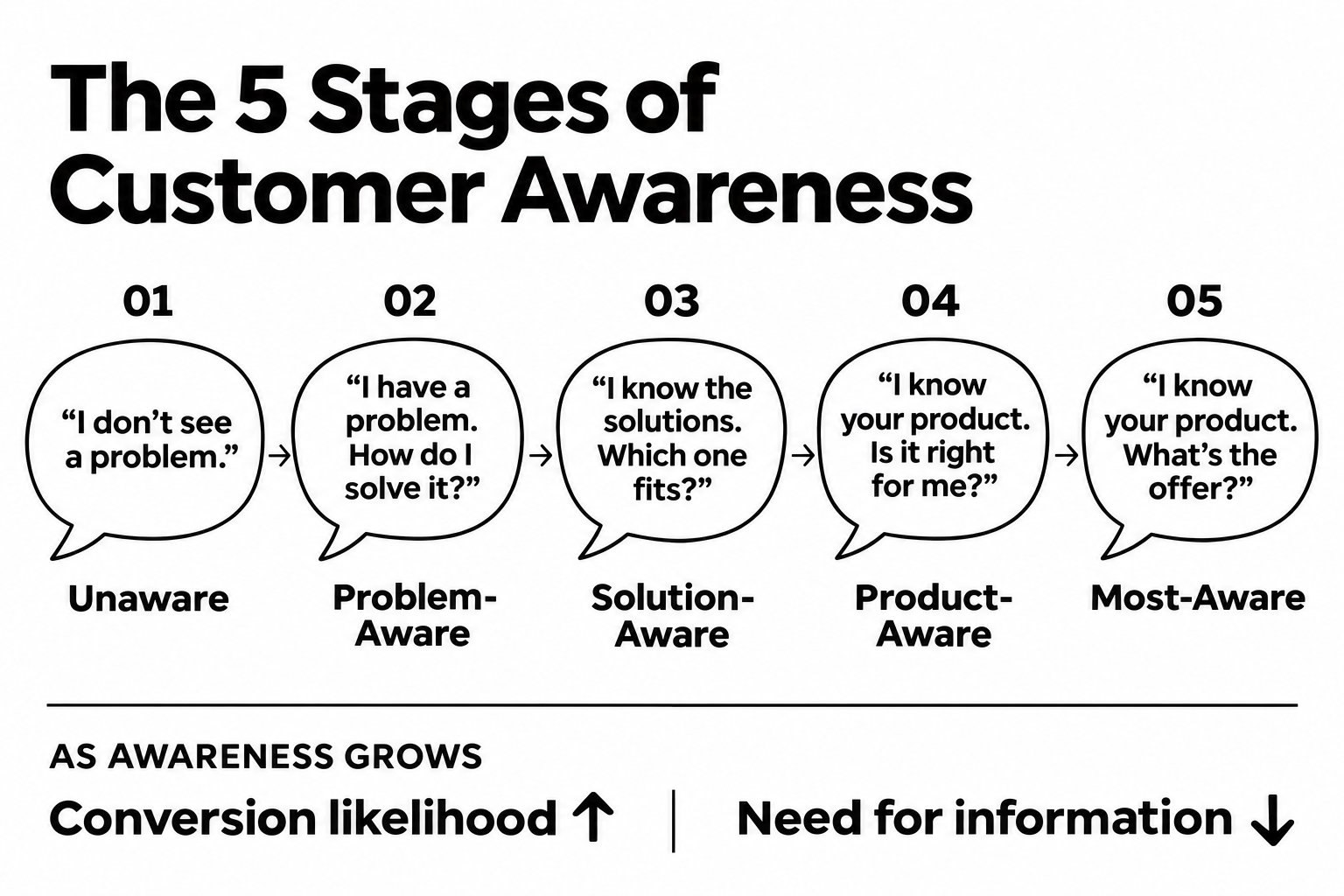
Quick answer: The 5 levels of awareness come from copywriter Eugene Schwartz’s 1966 book Breakthrough Advertising. They describe how much a prospect knows when they meet your message: Unaware, Problem-Aware, Solution-Aware, Product-Aware and Most Aware. Each level asks a different question, so each needs a different message. A landing page converts best when its first screen answers the question its visitors are actually asking.
What Are the 5 Levels of Awareness?
In 1966, copywriter Eugene Schwartz described five states of prospect awareness in Breakthrough Advertising. Schwartz listed them starting from the most aware prospect. Today marketers usually present them the other way round, from Unaware to Most Aware, as in the graphic above.
| Level | The visitor’s question | What your page should do |
|---|---|---|
| 1. Unaware | “I don’t see a problem.” | Show them the problem and why it matters |
| 2. Problem-Aware | “How do I solve this?” | Show them a solution exists |
| 3. Solution-Aware | “Which solution fits?” | Show why your approach is the right one |
| 4. Product-Aware | “Is your product right for me?” | Give proof: reviews, comparisons, guarantees |
| 5. Most Aware | “What’s the offer?” | Give them the deal and a clear button |
The further along someone is, the more likely they are to convert and the less information they need. That’s why a long, educational page can bore a Most Aware visitor, and a short “Buy now” page loses an Unaware one.
Example: AC Cleaning in Dubai
Back to the example from my Google Ads series, where we used the keyword “AC cleaning Dubai” to explain Google Ads match types. The same business meets people at all five levels:
| Level | What the person does | What the first screen should say |
|---|---|---|
| Unaware | Doesn’t know a dirty AC raises the electricity bill | A dirty AC can quietly raise your bill |
| Problem-Aware | Searches “why does my AC smell” | The smell usually means it needs a deep clean |
| Solution-Aware | Searches “AC cleaning Dubai” | Why our cleaning method lasts longer |
| Product-Aware | Searches “Brand X AC cleaning reviews” | Reviews, before and after photos, a guarantee |
| Most Aware | Searches “Brand X discount code” | The offer and a Book now button |
Send all five to the same “Book now, 20% off” page, and you’ll mostly convert the last one. Your search terms report tells you which of these questions people were actually asking when they clicked.
What Decides How Much Work Your Landing Page Has to Do
1. Price and Complexity
A low-cost product can take someone from problem to purchase in one visit. A property or a B2B contract needs several steps, and often several pages, before anyone is ready to buy.
2. Traffic Source
| Traffic source | Visitors usually arrive | Your page should lead with |
|---|---|---|
| Search ads and organic search | Solution-Aware and Product-Aware | Why you, proof, then the offer |
| Brand searches and retargeting | Product-Aware and Most Aware | The offer and a clear button |
| Social feeds | Unaware and Problem-Aware | The problem and why it matters |
A low conversion rate isn’t always a design problem. Often it’s a mismatch between the page and the person landing on it. It’s also why Google rewards landing pages that match search intent: landing page experience is one of the three parts of Google Ads Quality Score, and quality is a big reason ads lose impression share to rank.
A 5-Minute Landing Page Check Before Any Redesign
I revisited this framework in the CXL landing page optimization course by Michael Aagaard, which has a full lesson on awareness levels and conversion goals. It’s a simple check worth running before you redesign anything:
- Open your top landing page and its main traffic source.
- Ask: which of the 5 questions is my visitor asking when they arrive?
- Check whether the first screen answers that question.
- If it doesn’t, change the message before you change the design.
- If one page gets very different visitors, split it: one page per awareness level.
More From the Blog
- Google Ads Quality Score: Why Higher Bids Don’t Always Win
- Google Ads Match Types: Why Exact Match Isn’t Exact Anymore
- Google Ads Search Terms Report: The First Check Every New Advertiser Should Make
- Lost Impression Share in Google Ads: Is It Budget or Rank?
- What Is Media Buying? The 185-Year History of a Middleman Job
Frequently Asked Questions
What are the 5 levels of awareness?
Unaware, Problem-Aware, Solution-Aware, Product-Aware and Most Aware. They describe how much a prospect knows about their problem, the possible solutions and your product when they meet your message.
Who created the 5 levels of awareness?
Copywriter Eugene Schwartz, in his 1966 book Breakthrough Advertising.
How do the stages of awareness apply to landing pages?
Each stage asks a different question, so the first screen of your landing page should answer the question your visitors are asking when they arrive. A mismatch between the page and the visitor’s awareness level is a common cause of low conversion rates.
Which awareness level do search ads usually reach?
Search usually brings Solution-Aware and Product-Aware visitors, because they’re already looking for a solution or a specific brand. Social feeds mostly reach Unaware and Problem-Aware people.
Should I send all ad traffic to one landing page?
Not if your visitors arrive at different awareness levels. A single “Book now” page mostly converts the Most Aware. Match each traffic source to a page that answers its visitors’ question.
Sources
- Breakthrough Advertising (1966), Open Library
- Landing Page Optimization Course, CXL
- About Quality Score, Google Ads Help
Which level do most of your customers arrive at? Tell me on LinkedIn, and subscribe on YouTube for more performance marketing breakdowns.
About the author: Amr Atef is a Dubai-based performance marketing specialist focused on Google Ads, conversion and marketing technology, and the builder of BenaAds. He writes a practical Google Ads series for new advertisers. Follow him on LinkedIn and YouTube, or read more about Amr.
