Honestly, isn’t it a bit embarrassing? A huge number of people around the world work in media buying today, yet hardly anyone knows where the term came from. Let’s look at the story together. Spoiler: we all started out as middlemen. Yes, really.
The first media buyer in history didn’t create ads at all. He bought advertising space in newspapers and resold it to advertisers. And media buying as a field is more than 180 years old.
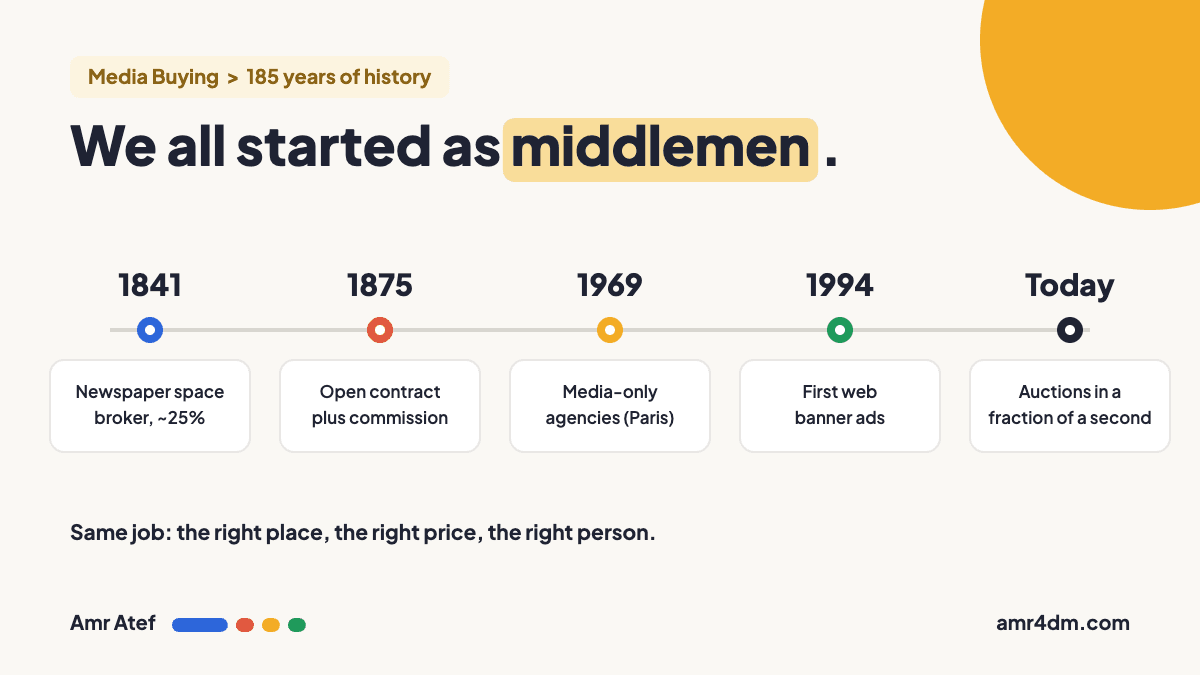
Quick answer: Media buying means buying space or time in a medium (a newspaper, radio, TV, a website or social media) to put an ad in front of people. It started in the 1840s with Volney Palmer, an American agent who bought newspaper space and resold it to advertisers for a commission of about 25%. Since then the tools have changed, from newspapers to Google and Meta auctions, but the job is the same: buy attention in the right place, at the right price, in front of the right person.
What Is Media Buying?
Split the term in two:
- Media: the plural of medium, the channel that carries your message to people. A newspaper, radio, TV, a website, social media.
- Buying: purchasing.
So the media buyer’s job, simply put, is buying space or time in that medium to put something in front of people. That something is the ad. A media buyer doesn’t have to write the ad, and for most of history they didn’t.
Media Buying vs Media Planning vs Creative
| Role | The question it answers | Typical output |
|---|---|---|
| Media planning | Where, when and how much should we advertise? | A media plan: channels, audiences, budget split |
| Media buying | How do we get that space or time at the best price, and keep it performing? | Placements, negotiated rates, live campaigns |
| Creative | What should the ad say and look like? | Copy, design, video |
In digital advertising these roles often sit with one person. A performance marketer running Google Ads plans, buys and often writes the ads too. But as you’ll see, they started as separate jobs.
The History of Media Buying in 5 Moments
Over the past posts in this series we’ve been talking about Google Ads and the auction that happens every time someone searches. Today we’re taking a step back, about two centuries.
1841: The First Media Buyer Was a Middleman
In 1841, an American named Volney B. Palmer opened what historians call the first advertising agency in the United States. His business was simple: buy newspaper space at a discount, then sell it to merchants who wanted to advertise. He earned a commission of about 25%, paid by the newspaper publishers.
The surprise? He didn’t create the ad itself. The advertiser wrote and designed it. Palmer only bought the space. And notice who paid him: the commission came from the newspaper publishers, not the advertisers.
1875: N.W. Ayer and the Open Contract
N.W. Ayer & Son, founded in Philadelphia in 1869, changed the model in 1875 with the open contract. Instead of quietly reselling space at a markup, Ayer promised clients the lowest rates it could get from publications and charged a commission on top. That commission eventually settled at 15% and became the industry standard for decades.
What is that 15% called today? It’s the classic agency commission, and you can still see it in media pricing as the gap between gross and net rates. Net is usually 15% below gross: a $10,000 gross buy costs the agency $8,500 net, and the difference is the commission.
Agencies like Ayer then started handling the concept, copywriting and production of ads as well as placing them. That’s how the split between creative and media was born inside the same agency.
1969: Media Buying Becomes Its Own Profession
In 1969, Gilbert Gross founded Carat in Paris, one of the earliest companies built around media alone, separate from creative. Carat is widely credited with helping start the era of media services sold on their own, and its move into the US in the 1990s inspired many Madison Avenue agencies to unbundle media from creative. From here, media buying became a profession in its own right.
1994: The First Banner Ads on the Web
On October 27, 1994, HotWired, the online arm of Wired magazine, launched with the first banner ads on the web. AT&T’s ad is the one most people remember, but around a dozen brands ran at launch. The person HotWired brought in to organize selling those ads, Rick Boyce, had previously worked as a media buyer at the San Francisco agency Hal Riney & Partners. Online advertising was built by a media buyer from day one.
Today: An Auction in a Fraction of a Second
Today you’re doing exactly the same job: buying space in front of people. Except instead of negotiating with a newspaper, you enter an auction on Google or Meta that ends in a fraction of a second. In Google Ads, whether you win that space depends on your ad quality and Ad Rank, not just your bid.
| Year | What happened | What the media buyer did |
|---|---|---|
| 1841 | Volney Palmer opens the first US ad agency | Bought newspaper space and resold it for about 25% |
| 1875 | N.W. Ayer introduces the open contract | Bought space at the lowest rates plus a commission, later 15% |
| 1969 | Carat is founded in Paris | Media buying becomes a specialist service, separate from creative |
| 1994 | First banner ads on HotWired | A former agency media buyer helps sell the web’s first ad space |
| Today | Google and Meta ad auctions | Bids for attention in real time, every search and every scroll |
You might have been a media buyer for years, running campaigns with big budgets, and nobody ever told you your profession started with a newspaper middleman.
What Hasn’t Changed in 185 Years
The tools changed, from newspapers to TV to Google and Meta, but the job is still built on three things:
| The job | In 1841 | In Google Ads today |
|---|---|---|
| The right place | Which newspaper, which page | Which searches and which locations: match types and location targeting |
| The right price | Negotiating the space rate | Ad Rank, bids and budget: lost impression share tells you if budget or rank is holding you back |
| The right person | The paper’s readers | The people who actually saw your ad: the search terms report |
Buy attention in the right place, at the right price, in front of the right person. Palmer would recognize the job instantly. He just wouldn’t believe how fast the auction is.
Keep Reading: The Google Ads Series
- Lost Impression Share in Google Ads: Is It Budget or Rank?
- Google Ads Location Targeting: Presence vs Presence or Interest
- Google Ads Ad Strength: Does It Matter? Why a Poor Ad Can Still Win
- Google Ads Match Types: Why Exact Match Isn’t Exact Anymore
- Google Ads Search Terms Report: The First Check Every New Advertiser Should Make
- Google Ads Quality Score: Why Higher Bids Don’t Always Win
Frequently Asked Questions
What is media buying?
Media buying is buying space or time in a medium, such as a newspaper, TV, a website or social media, to put an ad in front of people. Today most digital media buying happens through ad auctions on platforms like Google and Meta.
Who was the first media buyer?
Volney B. Palmer, who opened the first advertising agency in the United States in 1841. He bought newspaper space and resold it to advertisers for a commission of about 25%, without creating the ads himself.
How old is media buying?
More than 180 years. It dates back to Volney Palmer’s agency in 1841.
What is the 15% agency commission?
It’s the commission advertising agencies traditionally earned on media they bought, made standard after N.W. Ayer’s open contract. It’s why net media rates are usually 15% below gross rates.
What is the difference between media buying and media planning?
Media planning decides where, when and how much to advertise. Media buying secures that space or time at the best price and keeps the placements performing.
When was the first banner ad?
On October 27, 1994, when HotWired launched with banner ads from around a dozen brands, including AT&T.
Sources
- Emergence of Advertising in America: Timeline, Duke University Libraries
- Early Developments in American Advertising, Media & Culture (Macmillan)
- F. Wayland Ayer, Advertising Hall of Fame
- Gross vs. Net Costs in Advertising, Chron
- Carat Founder Gilbert Gross, Dead At 87, MediaPost
- An oral history of the first banner ad, Digiday
- Rick Boyce, Wikipedia
Want more stories like this from the history of advertising? Tell me on LinkedIn, and subscribe on YouTube for more.
About the author: Amr Atef is a Dubai-based performance marketing specialist focused on Google Ads and marketing technology, and the builder of BenaAds. He writes a practical Google Ads series for new advertisers. Follow him on LinkedIn and YouTube, or read more about Amr.
