The weekend flies by before you notice it, a bit like this Google Ads metric that most advertisers stare at without asking what it actually does: Ad Strength.
I once got into an argument with someone who was convinced Ad Strength was the reason an ad performs well. I ended it with the magic sentence, “you’re right,” and went to take a calming pill. Because Google itself says Ad Strength isn’t part of the auction at all. It’s a guide, not a requirement. Here’s why, and how to use it properly.
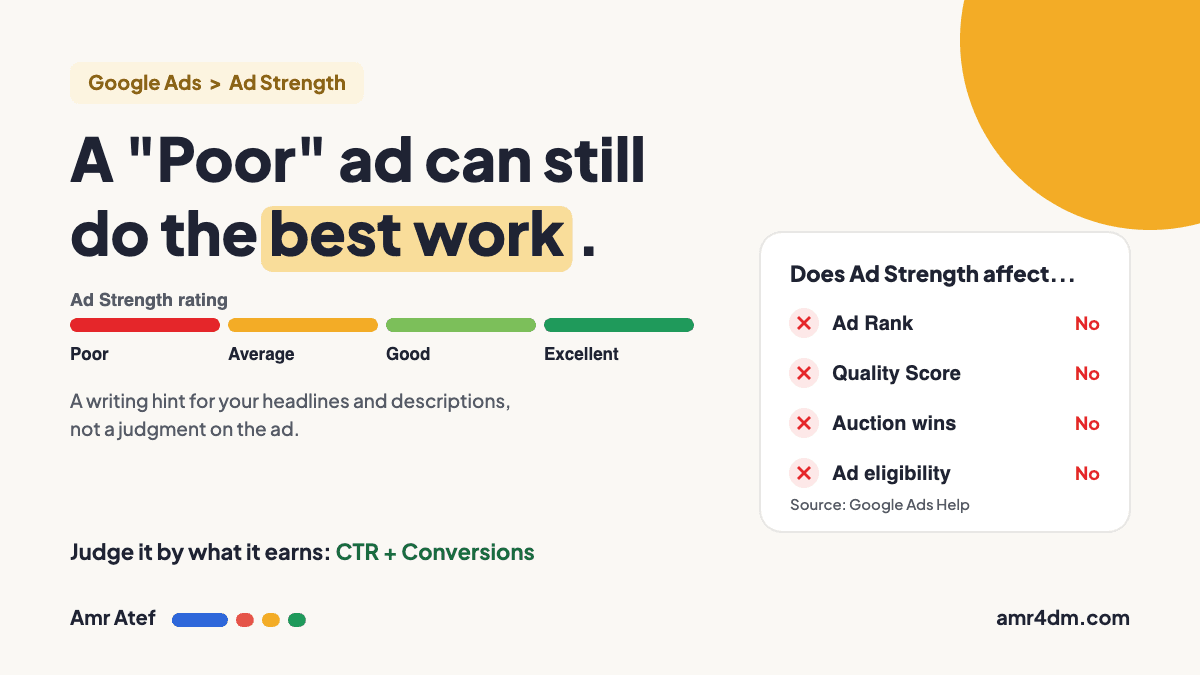
Quick answer: Ad Strength is a Poor to Excellent rating Google shows for responsive search ads. It checks how relevant, varied and complete your headlines and descriptions are. Google says it isn’t used to calculate Ad Rank, Quality Score or auction wins, and it doesn’t decide whether your ad can serve. Use it as a writing checklist, and judge the ad by CTR and conversions.
- Ad Strength rates your ad copy, not your ad’s performance.
- A Poor rating can be completely normal, for example in competitor campaigns.
- Pin what must show (brand, key offer, legal text) even if the rating drops.
- CTR and conversions are the real verdict.
What Is Ad Strength in Google Ads?
To understand Ad Strength, start with the ad it rates. A responsive search ad (RSA), one of the most important ad formats in Google Ads, lets you write up to 15 headlines and 4 descriptions. Google then mixes them into different versions of the ad depending on who is searching and what they typed.
| Asset | Minimum | Maximum | Character limit |
|---|---|---|---|
| Headlines | 3 | 15 | 30 each |
| Descriptions | 2 | 4 | 90 each |
| Display path | 0 | 2 fields | 15 each |
Ad Strength rates that set of assets on five levels: Incomplete, Poor, Average, Good and Excellent. In practice it checks one thing: are your headlines and descriptions varied enough, and do they include the keywords you’re targeting? You’ll see it while you write the ad, updating as you add or edit headlines, and in the Ad strength column of your ads table. Google’s full rules are in its responsive search ads guide.
Does Ad Strength Matter? What Google Actually Says
This is the part that ends arguments. Google’s help page on Ad Strength says it isn’t used to calculate Ad Rank, Quality Score or auction wins, and that it doesn’t decide whether your ad is eligible to serve. Google’s Ads Liaison, Ginny Marvin, has said the same in public: Ad Strength is not used in the auction.
Ad Strength vs Quality Score vs Ad Rank
| Ad Strength | Quality Score | Ad Rank | |
|---|---|---|---|
| What it rates | Your RSA headlines and descriptions | Each keyword: expected CTR, ad relevance, landing page experience | Your ad in each individual auction |
| Scale | Incomplete to Excellent | 1 to 10 | Not shown |
| Decides if or where your ad shows? | No | No, it’s a diagnostic | Yes |
| Best used for | Writing better ad copy | Spotting weak keywords, ads or landing pages | Understanding why you show, or don’t |
Ad relevance does matter in the auction, but it’s measured against what people search, not against a checklist. For the full picture of how ad quality works, read my guide to Google Ads Quality Score.
So Why Does Google Push It So Hard?
Because more varied, relevant assets give Google more combinations to test and match to different searches. Google’s help page says advertisers who raise Ad Strength from Poor to Excellent see 15% more conversions on average, based on its own internal data from August 2025. That’s Google’s figure across many accounts, not a promise for yours. Treat a higher rating as a sign your copy gives the system enough to work with, then let your results decide.
If a Google rep has ever pushed you to hit Excellent on every ad, my guide on whether Google Ads reps are sales or support (in Arabic) explains how to handle those recommendations.
Why Is My Ad Strength Poor?
These are the usual reasons, and whether each one is worth fixing:
| Reason | What Ad Strength sees | Fix it? |
|---|---|---|
| Too few headlines or descriptions | Not enough combinations to test | Yes, add more unique assets |
| Repetitive headlines | Several headlines saying the same thing | Yes, vary benefits, offers and calls to action |
| Missing popular keywords | Your main keywords aren’t in the headlines | Usually yes, unless you can’t use them |
| Several headlines pinned to one position | Fewer possible combinations | Only if those pins aren’t essential |
| Competitor campaign | Competitor names missing from your headlines | No, this is expected |
Why Competitor Campaigns Often Show “Poor” and Still Work
Here’s a case where Poor is completely normal. In a competitor campaign, your keywords are other brands’ names. Ad Strength wants to see those keywords in your headlines, but you usually can’t, and shouldn’t, put them there. Google’s trademark policy allows trademarks as keywords, but it can restrict a trademark in ad text after the owner files a complaint, and it restricts using a trademark in a confusing or misleading way.
So your headlines talk about your own brand and offer, Ad Strength reads that as “missing keywords” and shows Poor, and the campaign can still bring in clicks and leads at a good cost. Someone comparing options is often happy to click a strong alternative.
How to Use Ad Strength the Right Way
1. Use It as a Checklist While You Write
Let Ad Strength tell you whether your headlines are varied enough and include your main keywords. These moves improve the rating without hurting the ad:
- Add as many genuinely different headlines as you can, up to 15.
- Mix angles: benefit, offer, proof, and a clear call to action.
- Use the popular keywords Google suggests while you create the ad.
- Fill all 4 descriptions instead of stopping at 2.
2. Pin What Has to Show, Even If the Rating Drops
If a headline must appear in every ad, like your brand name, a key offer or legal text, pin it. Google confirms pinning reduces the combinations available and can lower Ad Strength, so pin only one or two essentials. Content pinned to Headline 1, Headline 2 or Description 1 always shows, while Headline 3 and Description 2 aren’t guaranteed. A lower rating is fine here, because what the searcher actually sees matters more than the score.
3. Judge the Ad by CTR and Conversions
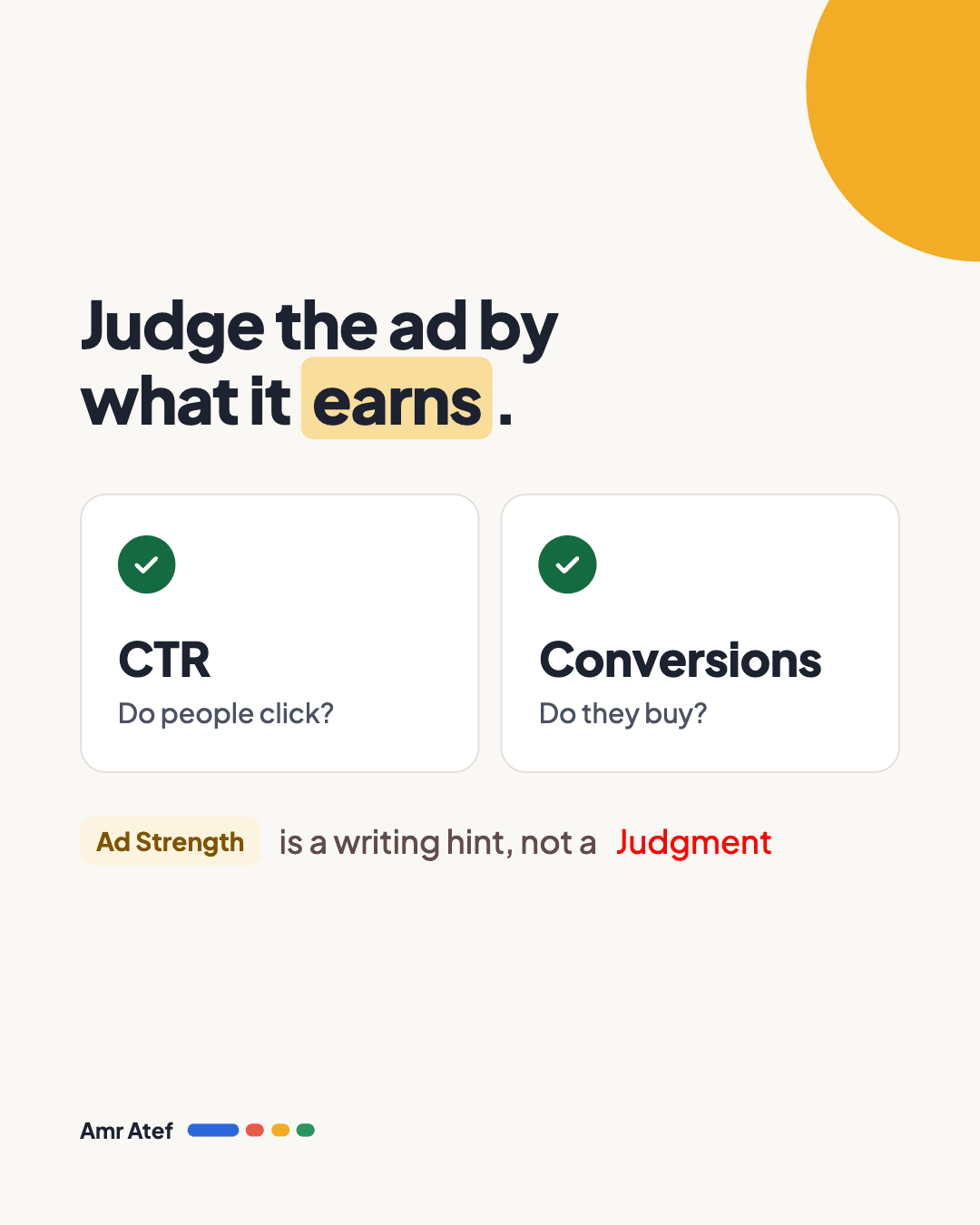
The real verdict is what the ad earns. CTR tells you whether people click. Conversions tell you whether they buy or send a lead. Compare ads in the same ad group on those two numbers, and open the asset details to see which headlines Google serves most.
A high CTR only helps if the right people are clicking. Pair this with a regular look at your search terms report and the right Google Ads match types.
When to Chase a Better Rating, and When to Ignore It
| Improve the rating when | Ignore the rating when |
|---|---|
| The ad has only a few headlines | It’s a competitor campaign |
| Your headlines repeat the same message | You pinned brand, offer or legal text on purpose |
| Your main keywords are missing from the copy | The ad already beats the others on CTR and conversions |
More From This Google Ads Series
- Google Ads Match Types: Why Exact Match Isn’t Exact Anymore
- Google Ads Search Terms Report: The First Check Every New Advertiser Should Make
- Google Ads Quality Score: Why Higher Bids Don’t Always Win
- Search Term Mining in Google Ads: A Practical Guide
Frequently Asked Questions
What is Ad Strength in Google Ads?
Ad Strength is a rating from Poor to Excellent that Google shows for responsive search ads. It checks how relevant, varied and complete your headlines and descriptions are, mainly in relation to the keywords you target.
Does Ad Strength affect Quality Score or Ad Rank?
No. Google says Ad Strength isn’t used to calculate Ad Rank, Quality Score or auction wins, and it doesn’t decide whether your ad is eligible to serve.
Why is my Ad Strength poor?
Usually because the ad has too few headlines, the headlines repeat each other, your main keywords are missing, or several headlines are pinned. In competitor campaigns, Poor is normal because you can’t use competitor names in the ad text.
Do I need Excellent Ad Strength?
No. An Excellent rating means your copy gives Google plenty to work with, but the ad’s real performance is measured by CTR and conversions. A Poor or Average ad can outperform an Excellent one.
Does pinning headlines lower Ad Strength?
Yes, pinning reduces the number of combinations Google can test, which can lower the rating. Pin only what must appear in every ad, such as your brand name, a key offer or legal text.
How many headlines and descriptions can a responsive search ad have?
Up to 15 headlines of 30 characters each and up to 4 descriptions of 90 characters each. The minimum is 3 headlines and 2 descriptions.
Sources
- About Ad Strength for responsive search ads, Google Ads Help
- About responsive search ads, Google Ads Help
- Trademarks, Google Advertising Policies Help
- Google: Ad Strength Is Not Used In Ad Auction, Search Engine Roundtable
Has a “Poor” ad ever beaten an “Excellent” one in your account? Tell me on LinkedIn, and subscribe on YouTube for more Google Ads breakdowns.
About the author: Amr Atef is a Dubai-based performance marketing specialist focused on Google Ads and marketing technology, and the builder of BenaAds. He writes this practical Google Ads series for new advertisers. Follow him on LinkedIn and YouTube, or read more about Amr.
