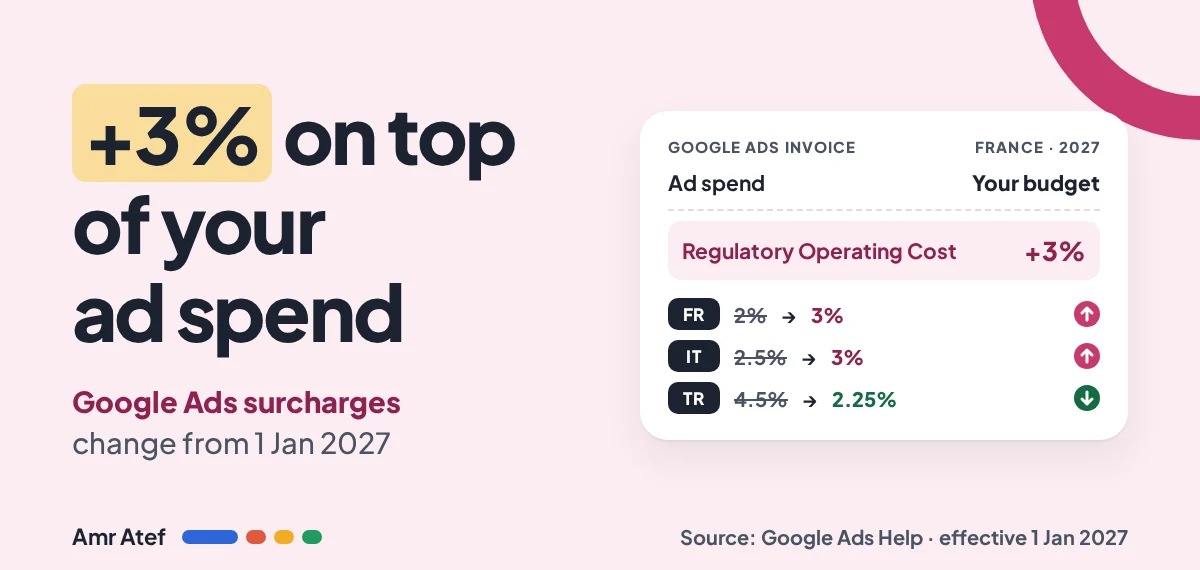
Your real CPA in France and Italy goes up on January 1, 2027, and your Google Ads dashboard won’t show it. Google has updated its Google Ads surcharges: the Regulatory Operating Cost for ads served in France rises from 2% to 3%, Italy goes from 2.5% to 3%, and Turkey drops from 4.5% to 2.25%. These charges land on your invoice, not in your campaign reports. So if you run France or Italy for a client or a brand, every CPA, ROAS and target you set in the UI starts to understate what you really pay. Here’s what changed, what it does to your numbers, and what I’d fix before the end of December 2026.
Quick answer: From January 1, 2027, Google adds a 3% Regulatory Operating Cost to ads served in France (up from 2%) and Italy (up from 2.5%), and cuts the Turkey charge from 4.5% to 2.25%. The charge depends on where the ad is served, not where your business is. It’s added once a month on top of your ad costs and any account budget, taxes such as VAT apply on top of it, and it shows as a separate line per country on your invoice and in Billing > Transactions.
- Gross up your target CPA and target ROAS for France and Italy by about 3%.
- Update client quotes and contracts so the surcharge is passed through.
- Check where your ads are actually served. Presence or interest targeting can leak spend into these countries.
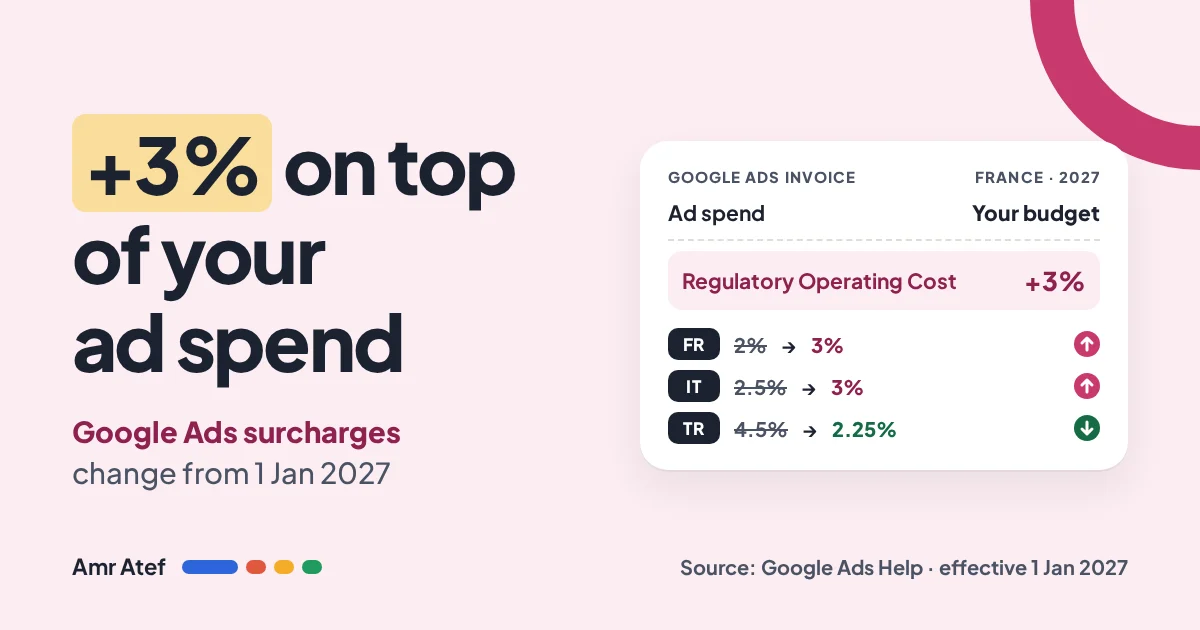
What Changed: Old vs New Google Ads Surcharges
The source is Google’s own jurisdiction-specific surcharges help page. Three rows change on January 1, 2027:
| Country | Charge | Until Dec 31, 2026 | From Jan 1, 2027 | Google’s stated reason |
|---|---|---|---|---|
| France | Regulatory Operating Cost | 2% | 3% | Part of the cost of complying with Digital Services Tax legislation |
| Italy | Regulatory Operating Cost | 2.5% | 3% | Part of the cost of complying with Digital Services Tax legislation |
| Turkey | Regulatory Operating Cost | 4.5% | 2.25% | Complexity and cost of complying with local regulations |
The rest of the list doesn’t change. Spain stays at a 3% Regulatory Operating Cost (since July 1, 2024). Austria keeps its 5% DST Fee and the UK its 2% DST Fee, both since November 1, 2020. Two countries are already off the list: Google says ads served in Canada are no longer charged the 2.5% DST fee as of July 1, 2025, and India’s 2% Regulatory Operating Cost ended on September 1, 2024.
From January 2027, France, Italy and Spain all sit at 3%. According to PPC Land, citing Search Engine Journal, Google Payments emailed advertisers about the French and Italian increases on November 11, 2026. If you manage several accounts, check the billing contacts. That email may have gone to a finance inbox nobody on the media team reads.
How Google Ads Surcharges Are Charged
Before you change anything, it helps to know exactly how the charge works. Five rules from Google’s page:
- It follows where the ad is served, not where you are. The charge is based on impressions or clicks served in each country, “regardless of where your actual business is located”. A Dubai brand advertising to Paris pays it the same way a Paris agency does.
- It’s added once a month. Google adds the surcharges to your costs one time at the end of each month, paid the next time you’re charged.
- It sits on top of your account budget. Google’s own example: a €100 account budget that accrues €5 in Austria DST fees gets billed €105. In other words, an account budget doesn’t cap the surcharge.
- Taxes come on top of the surcharge. VAT, GST or sales tax that applies to your account is charged on the surcharge too.
- It’s a separate line. Each country appears as its own line item on the monthly invoice or statement, and under Billing > Transactions.
Prepay accounts work a bit differently. The surcharge may be taken after your payment is spent, which can leave an open balance that’s deducted from your next payment. Google’s example: €7 of Turkey charges against a €100 payment leaves €93 for ads.
It isn’t only Search and Performance Max. The same page covers YouTube placements bought on a reservation basis. Display & Video 360 has its own country-specific surcharges page with the same 2027 rates for France, Italy and Turkey, calculated on the media cost of impressions served in those countries.
Why Your Dashboard CPA Is Now Wrong
Here’s the part that hurts. Your campaign reports show media cost. The Google Ads regulatory operating cost arrives a month later as a line on the invoice. Google’s help page doesn’t say the surcharge is included in the Cost column or that Smart Bidding can see it. So my working assumption, and the safe one, is this: every CPA, ROAS, tCPA and tROAS in the UI is calculated without the surcharge.
Let’s put numbers on it with a hypothetical example. A Dubai-based fashion e-commerce brand spends €10,000 a month on ads served in France. Those ads bring in 200 purchases and €40,000 in revenue.
| France, €10,000 media cost | What the UI shows | True cost in 2026 (2%) | True cost in 2027 (3%) |
|---|---|---|---|
| Surcharge | Not shown | €200 | €300 |
| Total before VAT | €10,000 | €10,200 | €10,300 |
| CPA (200 purchases) | €50.00 | €51.00 | €51.50 |
| ROAS (€40,000 revenue) | 4.00 | 3.92 | 3.88 |
That’s €100 more a month in France in 2027 than in 2026, or €1,200 a year, before any VAT that applies to your billing setup. Not a disaster. But it’s invisible, it compounds across every France and Italy account you run, and nobody notices it until finance asks why the invoice doesn’t match the dashboard.
Now add the other two countries, still hypothetical. Say the same brand also spends €6,000 a month in Italy and €4,000 in Turkey:
| Country (monthly media cost) | Surcharge in 2026 | Surcharge in 2027 | Change |
|---|---|---|---|
| France (€10,000) | €200 | €300 | +€100 |
| Italy (€6,000) | €150 | €180 | +€30 |
| Turkey (€4,000) | €180 | €90 | −€90 |
| Total | €530 | €570 | +€40 |
The blended account barely moves. The countries do. France gets more expensive, Turkey gets cheaper, and if you only look at the account total you’ll miss both. That’s why I’d model Google Ads surcharges per country, not per account.
What to Do Before January 2027
1. Adjust targets and margin models per country
If your bid strategy targets are set from your true break-even, gross them up for the surcharge. The math is simple:
- Target ROAS: UI target = true target × (1 + surcharge). To hit a true 4.0 ROAS in France in 2027, set about 4.12 in the UI.
- Target CPA: UI target = true target ÷ (1 + surcharge). A true €50 target CPA in France becomes about €48.54 in the UI.
This only works cleanly if France, Italy or Turkey have their own campaigns. If one campaign targets France, Germany and Spain together, Smart Bidding can’t apply a different target per country. In that case, use the blended surcharge for that campaign, or think about splitting the high-surcharge countries out. Any structural change like that is worth testing first, which is what Google Ads experiments are for.
Do the same in your margin model or profit dashboard. If you pull Google Ads cost into a sheet or BI tool, add a column for surcharge by country and calculate profit on cost plus surcharge. If you plan budgets across channels in GA4, remember that GA4 cross-channel budgeting works from imported cost data, so the surcharge won’t be in there either unless you add it.
2. Update client quotes and contracts
Agencies, this one’s for you. If your media plan for a French or Italian client was quoted on media cost, your 2027 numbers are already off by up to a point. My recommendation, not legal advice:
- Add a pass-through clause: platform surcharges, DST fees and regulatory costs are billed to the client at cost, on top of media.
- Say whether your management fee is calculated on media cost alone or on media plus surcharges. Decide it now, not when the first invoice arrives.
- If you resell media on your own account, update the rate card for France and Italy from January 1, 2027, and for Turkey too, so the client gets the reduction.
3. Reconcile invoices against the line items
When the January 2027 invoice arrives in early February, open Billing > Transactions and check the France, Italy and Turkey lines against your geo spend. Roughly, each line should be the media cost served in that country times its rate. If a line is much bigger than you expected, the next step tells you why. Tools that pull spend from several accounts, like the setup in my Supermetrics campaign management article, make this a five-minute check instead of an afternoon.
4. Check where your ads are actually served
This is where most of the surprise cost hides. Google Ads surcharges follow where the ad was served, and Google says plainly that a campaign can serve in a country it doesn’t explicitly target. Its example is ads showing to users in the UK because your business location is of interest to them.
The usual cause is the location option Presence or interest. A campaign targeting the UAE can still show to someone sitting in Paris who searches about Dubai. That click gets the France surcharge. Google also states that it won’t refund the surcharges for legitimate clicks and impressions served according to your campaign target settings. I covered this setting in detail in my Google Ads location targeting guide.
To see where you’re really serving, Google’s page gives these steps:
- Go to Campaigns > Insights and reports > Report editor.
- Choose the Distance template and create the predefined report.
- Remove all default rows.
- Add Country/Territory (user location) as a row.
If France, Italy or Turkey show up and you didn’t mean to be there, either exclude them or switch the location option to Presence. If you did mean to be there, at least you now know the real cost.
Turkey Is the Good News
Turkey’s Regulatory Operating Cost halves, from 4.5% to 2.25%. On €4,000 a month that’s €90 less, every month. According to PPC Land, citing EY, Turkey is also cutting its own digital services tax from 5% in 2026 to 2.5% in 2027, under Presidential Decision No. 10767. Google’s page doesn’t link the two, so treat that as context, not Google’s explanation.
For brands in the Gulf and MENA region, Turkey is often a test market: large population, strong e-commerce, and cheaper clicks than Western Europe. Lower overhead makes the 2027 test a little cheaper. If Turkey has been on your list, January 2027 is a reasonable time to run it. Just set it up with its own campaign and budget so you can read it cleanly.
One more piece of context. According to PPC Land, citing Search Engine Journal, Meta began charging location fees on July 1, 2026, including 3% in France, Italy and Spain. If that’s right, moving budget from Google to Meta in those countries doesn’t avoid the cost. Plan the surcharge into your media buying as part of the country’s cost, whatever the platform.
Checklist
- List every account that serves ads in France, Italy or Turkey, including YouTube reservations and DV360.
- Run the Country/Territory (user location) report and look for countries you didn’t plan for.
- Switch campaigns that shouldn’t reach people abroad to Presence, or exclude the country.
- Gross up tROAS by about 3% and reduce tCPA by about 3% for France and Italy from January 1, 2027.
- Lower the Turkey adjustment from 4.5% to 2.25%.
- Add a surcharge column per country to your profit or margin model.
- Add or check the pass-through clause in client contracts and 2027 quotes.
- Agree whether your fee applies to surcharges.
- Reconcile the January 2027 invoice lines against geo spend in early February 2027.
- Make sure the person who receives Google Payments emails tells the media team.
More From the Blog
- Google Ads Location Targeting
- What Is Media Buying?
- GA4 Cross-Channel Budgeting
- Google Ads Conversion Tracking
- Google Ads Experiments
Frequently Asked Questions
What are Google Ads surcharges?
They are extra charges Google adds to your bill for ads served in certain countries, called DST Fees or Regulatory Operating Costs. From January 1, 2027, they are 3% for France, Italy and Spain, 5% for Austria, 2% for the UK and 2.25% for Turkey.
Do I pay the France surcharge if my business isn’t in France?
Yes. Google charges it based on impressions or clicks served in France, regardless of where your business is located. A business in Dubai advertising to people in France pays it.
Is the Google Ads regulatory operating cost included in my CPA and ROAS?
Google’s help page doesn’t say it’s included in campaign cost. It’s added once a month as a separate line on the invoice and in Billing > Transactions, so treat UI CPA and ROAS as media cost only and adjust targets yourself.
Does the surcharge count against my account budget?
No. Google adds it on top of your account budget. Its example: a €100 budget with €5 of Austria DST fees is billed €105, plus any VAT.
Is VAT charged on Google Ads surcharges?
Yes. Google says taxes such as VAT, GST or sales tax that apply in your jurisdiction are charged in addition to the surcharges.
How do I avoid paying surcharges for countries I don’t target?
Check the Country/Territory (user location) report. If you see unintended countries, switch the location option to Presence or exclude those countries. Google won’t refund surcharges for legitimate traffic served under your settings.
Sources
- Jurisdiction-specific surcharges, Google Ads Help
- Country-specific surcharges, Display & Video 360 Help
- Surcharges hit 3% in France and Italy from January 2027, PPC Land, November 22, 2026
Do you pass platform surcharges through to clients, or absorb them in your fee? Tell me on LinkedIn, and subscribe on YouTube for more paid media breakdowns.
About the author: Amr Atef is a Dubai-based performance marketing specialist focused on Google Ads and marketing technology, and the builder of BenaAds. He writes a practical Google Ads series for new advertisers. Follow him on LinkedIn and YouTube, or read more about Amr.
